Mass Spectrometry – Qualitative Analysis

Introduction to Mass Spectrometry

⚗️ Mass Spectrometry is a powerful analytical technique used to measure the mass-to-charge ratio (m/z) of ions. It is particularly useful for:

Applications of Mass Spectrometry:

  • Determining molecular masses of compounds
  • Analyzing relative abundances of isotopes
  • Elucidating molecular structures through fragmentation patterns
  • Identifying elements like chlorine and bromine in compounds
  • Studying reaction mechanisms
/>

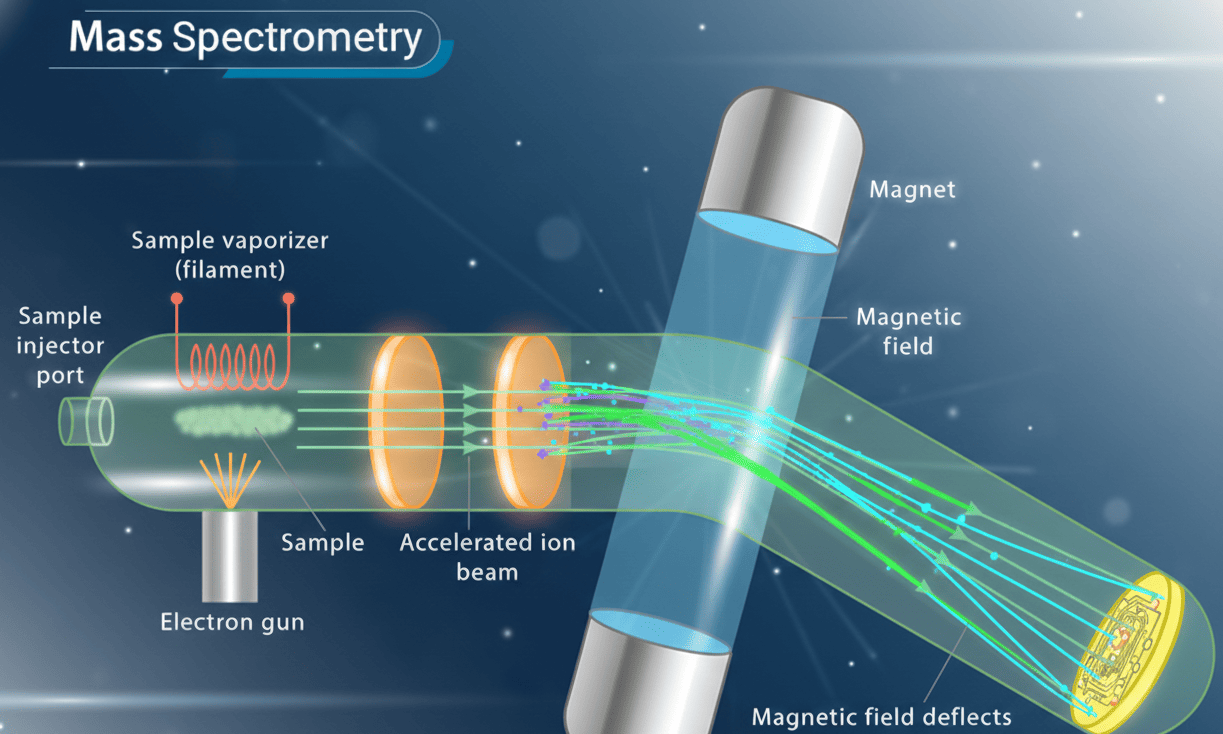
Mass Spectrometry Instrument Diagram

Key Concept:

In mass spectrometry, molecules are ionized and then separated based on their mass-to-charge ratio (m/z). The resulting spectrum provides valuable information about the compound’s composition and structure.

Analyzing Isotopes and Relative Abundances

Identifying Isotopes from Mass Spectra

📊 The number of peaks in a mass spectrum at proper m/z values indicates the number of isotopes present in an element.

Examples:

  • Chlorine: Two peaks in the mass spectrum indicate two isotopes (Cl-35 and Cl-37)
  • Hydrogen: Three peaks indicate three isotopes (protium, deuterium, and tritium)
  • Boron: Two peaks indicate two isotopes (B-10 and B-11)

The height of each peak represents the relative abundance of each isotope as a percentage.

Mass Spectrum of Boron

B-11 (80.1%)
B-10 (19.9%)
10
11
Mass Number Relative Abundance (%)
10 19.90%
11 80.10%

Calculating Relative Atomic Mass

🧮 The relative atomic mass of an element can be calculated using the formula:

Relative Atomic Mass = Σ(mass number × isotope abundance) / 100

Atomic Mass Calculator

Atomic mass will be calculated here
Calculation steps will appear here

Example: Boron

Using the data from the mass spectrum:

Avg. Atomic mass of Boron = (10 × 19.90) + (11 × 80.10) / 100 = 10.801 amu

Molecular Mass Determination

Identifying the Molecular Ion Peak

🔍 The molecular ion peak (M⁺) is the peak in a mass spectrum that represents the molecular ion. It has the highest m/z value (excluding heavier isotope peaks).

Characteristics of Molecular Ion Peak:

  • Represents the intact molecule with one electron removed (M⁺)
  • Has the highest m/z value in the spectrum (excluding isotope peaks)
  • The m/z value equals the molecular mass of the compound
  • May be small or absent for compounds that fragment easily

Mass Spectrum of Ethene (C₂H₄)

M⁺ (28)
Fragment (15)
Fragment (26)
0
15
26
28

Important Note:

The base peak is the most intense peak in the spectrum (assigned 100% relative abundance). It may or may not be the molecular ion peak.

M+1 and M+2 Peaks

📈 In addition to the molecular ion peak, mass spectra often show M+1 and M+2 peaks due to the presence of heavier isotopes.

M+1 Peak:

  • Caused by the presence of ¹³C isotope (natural abundance ~1.1%)
  • Appears at one m/z unit higher than the molecular ion peak
  • Intensity depends on the number of carbon atoms in the molecule

M+2 Peak:

  • Caused by the presence of two ¹³C atoms or other heavier isotopes
  • Appears at two m/z units higher than the molecular ion peak
  • Usually much smaller than M and M+1 peaks

Mass Spectrum showing M, M+1, and M+2 peaks

M⁺
M+1
M+2
M
M+1
M+2

Fragmentation Patterns and Structural Elucidation

Understanding Fragmentation

When molecules are bombarded with electrons in the mass spectrometer, they undergo fragmentation. The weakest bonds break first, forming the most stable fragments.

Common Fragmentation Patterns:

  • m/z = 15: CH₃⁺ (methyl cation)
  • m/z = 29: CH₃CH₂⁺ (ethyl cation)
  • m/z = 43: CH₃CH₂CH₂⁺ (propyl cation)
  • m/z = 57: C₄H₉⁺ (butyl cation)
  • m/z = 17: OH⁺ (from alcohols)
  • M-15: Loss of CH₃ group
  • M-18: Loss of H₂O (from alcohols)

Fragmentation of n-Pentane (C₅H₁₂)

C₅H₁₂⁺ (m/z = 72)
CH₃⁺ (m/z = 15) + C₄H₉•
C₅H₁₂⁺ (m/z = 72)
C₂H₅⁺ (m/z = 29) + C₃H₇•
C₅H₁₂⁺ (m/z = 72)
C₃H₇⁺ (m/z = 43) + C₂H₅•

Mass Spectrum of n-pentane

15
29
43
57
72
15
29
43
57
72

Memorization Tip:

Fragmentation Rule: Weakest bonds break first, forming the most stable carbocations.

Stability of carbocations: tertiary > secondary > primary > methyl

Calculating Number of Carbon Atoms

🔢 The number of carbon atoms in a molecule can be calculated using the relative intensities of the M and M+1 peaks:

Number of carbon atoms = (100 × abundance of M+1 peak) / (1.1 × abundance of M⁺ peak)

Carbon Atom Calculator

Number of carbon atoms will be calculated here
Calculation steps will appear here

Example Calculation:

For a compound with M⁺ peak abundance = 27.32% and M+1 peak abundance = 2.10%:

Number of carbon atoms = (100 × 2.10) / (1.1 × 27.32) = 6.94 ≈ 7 carbon atoms

Identifying Chlorine and Bromine in Compounds

Characteristic Isotope Patterns

🔬 Chlorine and bromine have characteristic isotope patterns in mass spectra due to their natural isotopic abundances.

Cl
Chlorine
Cl-35: 75.77%
Cl-37: 24.23%
Ratio: ~3:1
Br
Bromine
Br-79: 50.50%
Br-81: 49.50%
Ratio: ~1:1

Chlorine Detection:

  • M⁺ peak at m/z value corresponding to molecular mass with Cl-35
  • M+2 peak at m/z value 2 units higher with approximately 1/3 the intensity (due to Cl-37)
  • Example: Chloromethane (CH₃Cl) shows M⁺ at m/z = 50 and M+2 at m/z = 52

Mass Spectrum of Methyl Chloride (CH₃Cl)

M⁺ (50)
M+2 (52)
50
52

Bromine Detection:

  • M⁺ peak at m/z value corresponding to molecular mass with Br-79
  • M+2 peak at m/z value 2 units higher with approximately equal intensity (due to Br-81)
  • Example: Bromoethane (C₂H₅Br) shows M⁺ at m/z = 108 and M+2 at m/z = 110

Mass Spectrum of Ethyl Bromide (C₂H₅Br)

M⁺ (108)
M+2 (110)
108
110

Identification Tip:

Look for characteristic M+2 peaks with specific intensity ratios to identify chlorine (≈1:3) or bromine (≈1:1) in organic compounds.

Advanced Applications

Reaction Mechanism Studies

🔍 Mass spectrometry can be used to study reaction mechanisms by identifying intermediate cations and fragment ions formed during chemical reactions.

Applications in Mechanism Studies:

  • Identification of reactive intermediates
  • Tracking the pathway of complex reactions
  • Studying rearrangement reactions
  • Analyzing reaction kinetics

Analytical Advantage:

Mass spectrometry provides direct evidence for the presence of specific ions and fragments, offering insights into reaction pathways that are difficult to obtain by other methods.

Quick Quiz

1. What does the molecular ion peak (M⁺) represent in a mass spectrum?
The most abundant fragment
The intact molecule with one electron removed
The base peak of the spectrum
The M+1 isotope peak
2. How can you identify chlorine in a compound using mass spectrometry?
By the presence of an M+1 peak
By a peak at m/z = 35
By an M+2 peak with approximately 1/3 the intensity of the M⁺ peak
By a peak at m/z = 17
3. What is the formula to calculate the number of carbon atoms in a molecule using mass spectrometry data?
Number of C atoms = (M⁺ abundance) / (M+1 abundance)
Number of C atoms = (100 × M+1 abundance) / (1.1 × M⁺ abundance)
Number of C atoms = (M+1 abundance) × 100
Number of C atoms = (M⁺ m/z value) / 12
4. Which of the following is NOT a field of mass spectrometry?
Molecular mass determination
Relative abundance of isotopes
Concentration of molecules in a sample
Molecular structure elucidation